
THE FUTURE OF AMERICAN IT — FINAL
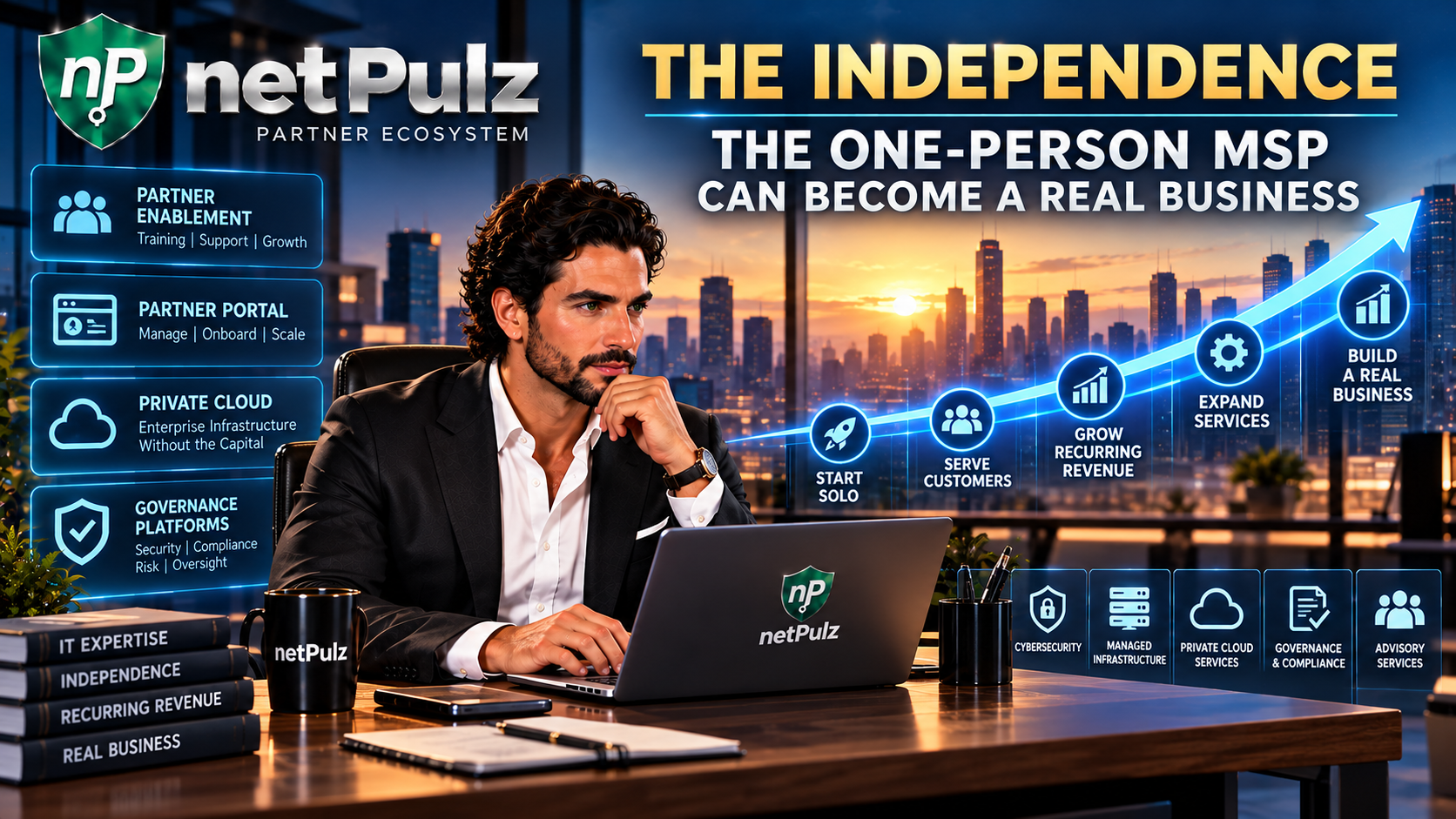
The Independence: The One-Person MSP Can Become a Real Business
How the netPulz partner enablement model, integrated partner portal, private cloud technology, and governance platforms can transform an independent IT professional into the owner of a scalable managed services business.
The Next Chapter of the American IT Career Is Ownership
For decades, the American IT professional followed a familiar career path. Learn the technology. Earn certifications. Join a company. Build experience. Advance into management. Perhaps become a director, vice president, or chief information officer.
That path created generations of capable technology professionals. But as we explored throughout this series, outsourcing, globalization, automation, and changing corporate priorities fundamentally altered the economics of IT employment.
The traditional career ladder became less predictable. Experienced professionals discovered that technical expertise did not always translate into employment security. Institutional knowledge became less valuable to organizations pursuing lower operating costs. And talented engineers, architects, administrators, and IT managers increasingly found themselves competing in a global labor market.
Yet something important survived these changes. The need for trusted, accountable, locally accessible technology expertise never disappeared. Small and midsized businesses still need cybersecurity, infrastructure, reliable computing, data protection, regulatory compliance, and strategic technology guidance. They need someone who understands their business, answers their calls, and accepts responsibility for results.
This creates an extraordinary opportunity. What if the experienced American IT professional stopped thinking exclusively about finding the next employer and started thinking about becoming the technology provider?
What if an IT manager, infrastructure architect, security specialist, or systems administrator could establish an independent managed services business without first raising significant capital, building a data center, hiring an engineering team, or purchasing an expensive collection of software platforms? What if one person could begin operating with the technological capabilities of a much larger managed services provider? That is the opportunity behind the netPulz MSP Partner Enablement Model.
1. The Traditional MSP Startup Problem
Starting a managed services provider has historically required more than technical competence. An independent professional must establish a business, attract customers, negotiate vendor relationships, select management tools, acquire infrastructure, implement security controls, create service agreements, organize billing, manage support, and develop repeatable service delivery processes.
Before winning the first meaningful customer, the entrepreneur may already face substantial operating expenses. Consider the technology stack a traditional MSP might need: • Cloud hosting and infrastructure management • Monitoring, administration, and endpoint management • Backup, disaster recovery, and business continuity • Cybersecurity and identity management • Compliance reporting and governance • Customer provisioning, subscriptions, and billing • Service delivery workflows and technical escalation
Each capability can introduce additional vendor contracts, training requirements, licensing commitments, and operational complexity. For a one-person business, this creates a dangerous contradiction.
The entrepreneur needs customers to finance the technology platform, but needs the technology platform to serve customers professionally. Growth becomes difficult because every new customer can introduce another set of tools, processes, and responsibilities.
This is why many talented independent consultants remain consultants rather than becoming business owners with recurring revenue and scalable operations. They sell their time instead of building an enterprise. The challenge is not a shortage of technical talent. It is the lack of an accessible business and technology operating model.
2. The netPulz Model: Business Ownership Without Building Everything Yourself
The netPulz MSP Partner Enablement Model is designed around a different principle. An independent IT professional should be able to own the customer relationship and build a business while leveraging a shared technology and operational foundation.
Instead of requiring every partner to independently assemble an entire managed services ecosystem, netPulz brings together partner enablement, a portal platform, private cloud capabilities, and governance-oriented technology offerings. The partner focuses on developing relationships, understanding customer requirements, positioning solutions, and delivering value. The underlying platforms provide the foundation on which services can be packaged, delivered, and expanded. This is an important distinction. The model is not simply about reselling another company's products.
It is about enabling an independent professional to establish a recurring-revenue technology business supported by capabilities that would otherwise be difficult to build alone. The partner can develop a market identity, specialize in selected industries, build a portfolio of customer relationships, and grow service revenue without necessarily owning every component of the underlying infrastructure. That changes the economics of entrepreneurship. It also changes the professional's identity.
From employee to entrepreneur. From hourly consultant to recurring-service provider. From technical contributor to business owner.
3. The Partner Portal: Turning Technical Expertise Into Business Operations
Technology alone does not create a successful MSP. A scalable business also requires an organized commercial and operational framework. This is where the netPulz partner portal becomes strategically important. The portal is intended to serve as the partner's operational gateway into the netPulz ecosystem, connecting the business side of customer relationships with the technology and services available through the platform.
For an independent professional, a centralized portal can reduce the administrative friction associated with managing multiple customers and service offerings. Rather than building separate systems for every business function, the partner can work within a common framework for service discovery, customer onboarding, subscriptions, and ongoing account management, according to the capabilities enabled in the program.
The strategic value extends beyond convenience. Standardized workflows make repeatable service delivery possible. Repeatability makes growth possible. A business serving five customers should not need five entirely different operating procedures. A business serving fifty customers should not require ten times the administrative effort. A common portal-based operating model helps move the entrepreneur away from improvised consulting and toward structured managed services. It also creates a foundation for future expansion.
As the partner's customer base grows, standardized processes can make it easier to delegate work, introduce additional specialists, and manage more complex service portfolios. The portal is not merely a place to access technology. It is a bridge between technical capability and commercial scalability.
4. The Private Cloud Platform: Enterprise Infrastructure Without Enterprise Capital
One of the largest barriers to establishing an infrastructure-focused MSP is the cost and complexity of delivering dependable computing resources. Traditional infrastructure businesses require investments in servers, storage, networking, virtualization, redundancy, security, facilities, and ongoing maintenance.
A one-person entrepreneur cannot realistically replicate the infrastructure investment of a large cloud provider. Nor should that be necessary.
The netPulz private cloud technology platform offers partners a foundation for positioning managed infrastructure services without independently constructing the entire hosting environment. Depending on customer needs and available service configurations, the partner can build offerings around private cloud workloads, managed computing environments, infrastructure modernization, and related services.
For customers, the value proposition is straightforward. They gain access to technology expertise and managed infrastructure through a trusted service relationship. For the partner, the economics can be fundamentally different from purchasing and operating dedicated infrastructure independently. The entrepreneur can concentrate on customer acquisition, architecture, solution design, migration planning, and ongoing service management. The platform supplies the infrastructure foundation. This can help shift the business from a capital-intensive model toward one with more variable, service-aligned costs, subject to the program's commercial terms. It also enables a more valuable conversation with customers.
Instead of asking, "How many hours of technical support do you need?" the partner can ask, "What computing environment does your business need, and how should it be managed?" The second conversation creates opportunities for long-term relationships and recurring services.
5. Governance Platforms: Moving Beyond IT Support Into Business Accountability
Infrastructure is important. Cybersecurity is essential. But an increasingly valuable opportunity for independent MSPs lies in governance. Organizations are under growing pressure to understand their technology risks, manage access, protect information, document policies, and demonstrate accountability. Many smaller businesses lack dedicated governance, risk, and compliance teams. They may have IT support, but no consistent framework for answering fundamental questions. Who has access to sensitive systems? Are critical technology assets documented? Which controls are operating effectively? What risks remain unresolved? Can management demonstrate that appropriate oversight exists?
These questions create an opportunity for a different kind of MSP relationship. The netPulz governance platform offerings provide a foundation for partners to develop services focused on visibility, control, oversight, and evidence-based management. Rather than limiting the relationship to troubleshooting, the partner can help customers establish recurring governance practices.
These may include technology assessments, control reviews, risk reporting, compliance-readiness support, policy coordination, and management-level technology oversight, depending on the specific platform capabilities and the partner's qualifications.
This is particularly attractive for experienced IT managers. Their value is not limited to configuring servers or resolving technical incidents. They understand organizational processes, technology dependencies, risk, vendor management, and executive accountability. Governance services allow them to monetize that experience.
A customer may need occasional infrastructure changes, but governance requires continuous attention. Risks evolve. Employees join and leave. Systems change. Regulations and contractual requirements develop. The opportunity is to establish a lasting advisory relationship. The MSP becomes more than the company that fixes technology. It becomes the partner that helps management remain accountable for technology.
6. The One-Person MSP: A Practical Growth Model
Imagine an experienced IT manager who has spent twenty years supporting corporate infrastructure. That professional understands networks, servers, virtualization, security, vendors, and business continuity. But starting a conventional MSP feels overwhelming.
The individual has neither the capital nor the desire to build a data center, hire a technical operations team, or integrate a dozen software products. With a platform-enabled model, the starting point changes.
Stage 1 — Establish the Business The professional develops a market identity, selects target customers, joins the partner ecosystem, and begins offering defined services supported by the netPulz platform.
Stage 2 — Acquire the First Customers Initial relationships might include local professional firms, small manufacturers, healthcare practices, or growing businesses seeking dependable IT oversight.
Stage 3 — Expand Recurring Services The partner introduces managed infrastructure, private cloud services, governance assessments, and ongoing technology oversight where appropriate.
Stage 4 — Build a Sustainable Enterprise As revenue and customer requirements increase, the partner can add subcontractors, specialized consultants, account management, or employees. The entrepreneur does not need to begin with a large organization.
The organization can grow around an established customer base.
7. The Economics: From Billable Hours to Recurring Revenue
The financial difference between consulting and managed services deserves attention.
An independent consultant billing $125 per hour for 120 hours per month generates $15,000 in monthly gross revenue. But that income depends on continuing to sell and perform billable work.
Vacation, illness, customer delays, and gaps between projects can directly affect revenue.
Now consider a hypothetical MSP model.
ILLUSTRATIVE MONTHLY REVENUE MODEL Managed customers 15 Average monthly service revenue per customer $1,500 Monthly gross revenue $22,500 Annualized gross revenue $270,000
Adjust the customer count and average monthly fee to explore possible revenue scenarios. These are hypothetical figures, not netPulz pricing, partner earnings projections, or profit estimates. Platform costs, labor, licensing, support, sales, and other expenses must be deducted. The objective is not to promise effortless income.
Recurring revenue introduces its own responsibilities: service-level commitments, customer retention, technical support, vendor dependencies, security obligations, and cash-flow management. But a properly structured recurring-revenue business can create something hourly consulting often struggles to produce.
Predictability. And predictable revenue can support hiring, investment, and long-term enterprise value.
8. Independence Does Not Mean Working Alone
One of the most important ideas behind the netPulz partner model is that business independence and technological self-sufficiency are not the same thing. A partner can own a business without owning a data center.
A partner can lead a customer relationship without personally developing every software platform. A partner can deliver sophisticated technology services while relying on specialized infrastructure and platform capabilities. This is how many modern businesses operate. They differentiate through relationships, expertise, accountability, and customer outcomes while using shared technology ecosystems. For the one-person MSP, this distinction is transformative. The professional's competitive advantage is not necessarily the ability to build everything. It is the ability to understand the customer, select appropriate solutions, manage expectations, and deliver dependable results.
The netPulz model aims to make the underlying capabilities more accessible. It does not eliminate the need for competence, diligence, insurance, contracts, or responsible business management. It can, however, reduce the number of things the entrepreneur must independently construct before entering the market.
9. Rebuilding the American IT Career Through Entrepreneurship
This opportunity connects directly to the larger argument of this series. The American IT industry cannot simply reverse decades of globalization. Nor should it reject international talent, legal immigration, or the economic benefits of global technology collaboration.
The challenge is to create new pathways for American professionals to participate meaningfully in the technology economy. Ownership is one such pathway. A skilled professional who establishes an MSP is not merely replacing a lost job.
That individual is creating a business capable of generating local economic activity, serving nearby organizations, purchasing services, paying taxes, and potentially employing additional professionals.
One successful MSP may begin with a single person. Over time, it may create opportunities for engineers, cybersecurity specialists, cloud architects, support technicians, and governance professionals. Not every independent MSP will grow into a large enterprise. Many may remain intentionally small and profitable. That is also a legitimate success. The goal is not to turn every IT professional into a multinational service provider. The goal is to make independence a credible career choice.
10. The Future MSP May Begin With One Person and a Platform
The next generation of managed services businesses may look very different from the traditional MSP. They may begin without an office. Without a data center. Without a large technical staff. Without years of infrastructure investment. They may begin with one experienced professional, a clearly defined customer market, a dependable partner ecosystem, and an integrated technology platform. That is the possibility netPulz seeks to enable through its partner model, portal, private cloud, and governance offerings. The real innovation is not simply making technology available.
It is reducing the distance between technical expertise and business ownership. For decades, experienced IT professionals helped build, operate, and protect other people's enterprises. Perhaps the next chapter is about giving more of those professionals the opportunity to build enterprises of their own. The American IT professional does not have to choose only between employment and unemployment, or between corporate advancement and career uncertainty. There is another path. Independence. And with the right business model, technology foundation, and partner ecosystem, a one-person MSP can become a real business.
About the netPulz MSP Partner Program netPulz is building a partner enablement ecosystem designed to help independent IT professionals, consultants, resellers, and emerging managed service providers establish and expand technology businesses. Through its partner portal, private cloud technology platform, and governance solutions, netPulz aims to reduce infrastructure and operational barriers while enabling partners to focus on customers, recurring services, and sustainable business growth. Explore the program: netPulz MSP Partner Program
Part 5 is the final article of the series on IT outsourcing, the American technology career, and the opportunity for independent managed service providers. The article describes the intended partner-enablement model; specific portal functions, commercial terms, service capabilities, and partner obligations should be verified against the current netPulz program before publication.